Friday, November 12, 2010

Fine Arts Friday: A Benefit of Working


Scrubwoman, by John French Sloan, 1910-1911

(Click on the paintings to get a better view.)

Here is a painting of scrub women working at the Astor Library in New York City, a place I used to spend a lot of time in as a reader. I like this painting, because it does not depict these ladies as victims of poverty-mandated drudgery, but instead draws our attention to their cheerfulness: they seem to be enjoying a friendly joke, although the shading of the painting indicates that they live in a different world than the silent scholars in the next room.

An atmosphere in which jokes are welcome is a crucial factor in selecting where I work. Once when I was a waitress at a New York City diner, if I made the slightest hint of a joke, the owner would snort, "Don't get fresh, Linda." It was dreary to work there, and I didn't last long. At another restaurant I worked in, all the waitresses, the cooks, the bartender, and the hands-on manager joked all day, and half the time I was in stitches. It was fun to work there. Even today, when I am buried under mountains of work on my job (the reason for the dribble of posts these last months), although the work is difficult and can be tedious, the atmosphere is convivial--which makes the job easier. If a spoil-sport like Ebenezer Scrooge ran the place, it would be intolerable. Women on the job jabber about their children, food, clothes, shopping, doing things for one another, their hobbies and crafts. Men report to each other on food, sports, trips, and sometimes (I overhear) what they are doing to keep their wives happy.

These conversations and jokes among fellow workers relieve tension, put a downward pressure on anxiety levels, and build team spirit to get a job done. It is a benefit of working.

John French Sloan (1871-1951) was a major figure of the Ashcan School of realist artists who resisted the pull of abstractionist art in the early decades of the 20th century. Born, raised, and trained in Philadelphia, he produced most of his art in New York City, where, he wrote in his diary, "I am in the habit of watching every bit of human life I can see about my windows, but I do it so that I am not observed at it ... No insult to the people you are watching to do so unseen."

I think he had a particular knack for portraying women in conversation, as these paintings show:


Sunday Women Drying Their Hair, 1912


Three A.M., 1909


Spring Planting in Greenwich Village, 1913

Although he looks a little taciturn himself...


Self Portrait, 1890

Monday, November 8, 2010

Preparing for Advent


Advent begins on Sunday, November 28, and it may seem strange to talk about preparing for a season that is itself all about preparation, but that is how the British writer, poet, and Catholic mystic, Caryll Houselander, begins her beautiful treasure, The Reed of God, written in 1944:

That virginal quality which, for want of a better word, I call emptiness is the beginning of this contemplation.

It is not a formless emptiness, a void without meaning; on the contrary it has a shape, a form given to it by the purpose for which it is intended.

It is emptiness like the hollow in the reed, the narrow riftless emptiness which can have only one destiny: to receive the piper's breath and to utter the song that is in his heart.

It is emptiness like the hollow in the cup, shaped to receive water or wine.

It is emptiness like that of the bird's nest, built in a round warm ring to receive the little bird.

The pre-Advent emptiness of Our Lady's purposeful virginity was indeed like those three things.

She was a reed through with the Eternal Love was to be piped as a shepherd's song.

She was the flower-like chalice into which the purest water of humanity was to be poured, mingled with wine, changed to the crimson blood of love, and lifted up in sacrifice.

She was the warm nest rounded to the shape of humanity to receive the Divine Little Bird.

Emptiness is a very common complaint in our days, not the purposeful emptiness of the virginal heart and mind but a void, meaningless, unhappy condition.

Strangely enough, those who complain the loudest of the emptiness of their lives are usually people whose lives are overcrowded, filled with trivial details, plans, desires, ambitions, unsatisfied cravings for passing pleasures, doubts, ambitions, unsatisfied cravings for passing pleasures, doubts, anxieties, and fears; and these sometimes further overlaid with exhausting pleasures which are an attempt, and always a futile attempt, to forget how pointless such people's lives are. Those who complain in these circumstances of their lives are usually afraid to allow space or silence or pause in their lives. They dread space, for they want material things crowded together, so that there will always be something to lean on for support. They dread silence because they do not want to hear their own pulses beating out the seconds of their life, and to know that each beat is another knock on the door of death. Death seems to them to be only the final void, the darkest, loneliest emptiness.

They have no sense of being related to any abiding beauty, to any indestructible life: they are afraid to be alone with their unrelated hearts.

Such emptiness is very different from that still, shadowless ring of light round which our being is circled, making a shape which in itself is an absolute promise of fulfillment.

The question which most people will ask is: "Can someone whose life is already cluttered up with trivial things get back to this virginal emptiness?"
Of course he can: if a bird's nest has been filled with broken glass and rubbish, it can be emptied.

It is not only trivialities which destroy this virgin mindedness; very often, serious people with a conscious purpose in life destroy it by being too set on this purpose. The core of emptiness is not filled by trifles but by a hard block, tightly wedged in. They have a plan, for example, for reconstructing Europe, for reforming education, for converting the world; and this plan, this enthusiasm, has become so important in their minds that there is neither room to receive God nor silence to hear His voice, even though He comes as light and little as a Communion wafer and speaks as soft as a zephyr of wind tapping on the window with a flower.

Zealots and triflers and all besides who have crowded the emptiness out of their minds and the silence out of their souls can restore it. At least, they can allow God to restore it and ask Him to do so.

The whole process of contemplation through imitation of Our Lady can be gone through, in the first place, with just the simple purpose of regaining the virgin-mind, and as we go on in the attempt we shall find that over and over again, there is a new emptying process; it is a thing which has to be done in contemplation as often as the earth has to be sifted and the field ploughed for seed.

At the beginning it will be necessary for each individual to discard deliberately all the trifling unnecessary things in his life, all the hard blocks and congestions; not necessarily to discard all his interests for ever, but at least once to stop still, and having prayed for courage, to visualize himself without all the extras, escapes, and interests other than Love in his life: to see ourselves as if we had just come from God's hand and had gathered nothing to ourselves yet, to discover just what shape is the virginal emptiness of our own being, and of what material we are made.

We need to be reminded that every second of our survival does really mean that we are new from God's fingers, so that it requires no more than the miracle which we never notice to restore us to our virgin-heart at any moment we like to choose.

Our own effort will consist in sifting and sorting out everything that is not essential and that fills up space and silence in us and in discovering what sort of shape this emptiness in us is. From this we shall learn what sort of purpose God has for us. In what way are we to fulfill the work of giving Christ life in us?

Are we reed pipes? Is He waiting to live lyrically through us?
Are we chalices? Does He ask to be sacrificed in us?

Are we nests? Does He desire of us a warm, sweet abiding in domestic life at home?
These are only some of the possible forms of virginity; each person may find some quite different form, his own secret.

I mention these three because they are all fulfilled in Our Lady, so visibly that we may be sure that we can look at them in her and learn what she reveals through them.


If you would like to read more writings of Caryll Houselander, many of her books are available at Albris, Barnes and Noble, and Borders.

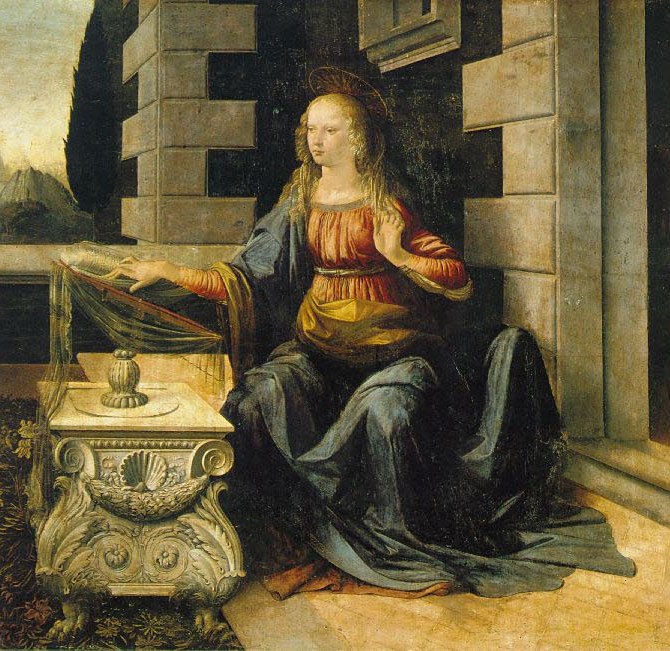
The painting is The Annunciation by Leonardo da Vinci, 1472-75.

Sunday, November 7, 2010

In Praise of the Linen Closet


Karin Larsson at the Linen Closet, by Carl Larsson, 1906. The artist's wife is carefully inspecting her linens. I like the large size of this beautiful cupboard--which holds a lot, unlike the narrow linen closets built into the upstairs hallway in many American homes.

I have always been impressed by a beautiful linen closet, so you can imagine how much I enjoyed this passage in Joy Street, a novel written by Frances Parkinson Keyes in 1950:
One afternoon, Emily [a new bride of upper-crust Boston society in the 1930s], led her husband to the spacious linen closet and, throwing open its double doors, revealed pile after pile of snowy sheets and pillowcases and towels, gartered with satin-covered elastic to insure perfect regularity, and scented with small bags of lavender nestling between each pile.


At the Linen Closet by Pieter de Hooch, 1663. The Dutch, the first to value housecleaning and whose art celebrated domesticity, naturally took their linen closets seriously. Here the mistress of the home returns sparkling clean sheets to the linen closet. Note the child playing hockey on the floor on the right, reminding us that chaos is always on the horizon.

The scene reminded me of a similar description in the book, Sweeping the German Nation: Domesticity and National Identity in Germany by Nancy Ruth Reagin. A non-German in the early 20th century visits the home of a German professor, whose wife:
"threw back both doors of an immense cupboard occupying the longest wall in the home... [For] their happiness, they possessed all this linen: shelf upon shelf, pile upon pile of linen, exactly ordered, tied with lemon coloured ribbons."

A German housewife was expected to wash her white linen and spread it out on the lawn for bleaching so it was snowy white before being laid in the closet.

I've always appreciate Martha Stewart's ideas about the linen closet, too, reading them in her magazine quite a few years ago. Here is a Martha Stewart Linen Closet Picture Gallery and a Martha Stewart Organize the Linen Closet Checklist.

Below a Martha Stewart linen closet--I love the eyelet border hanging over the edge of the shelves. Note ribbons.

Saturday, October 2, 2010

Meeting Mrs. Egg


Although Mrs. Egg was younger than the woman in this picture, she fed her 6'5" son with that kind of zest. Mrs. Egg was the creation of Thomas Beer, who wrote stories about the Eggs and other families for the Saturday Evening Post during the 1920s and 1930s. Most of his books are out of print. Reading about Mrs. Egg is like reading stories that Norman Rockwell would have liked to illustrate. Or was it the other way around--did Norman Rockwell, whose paintings graced the covers of the Saturday Evening Post--inspire Thomas Beer?

I was referred to Thomas Beer by William Faulkner. During his question and answer sessions at the University of Virginia, Faulkner was asked who were the major influences on his work. He replied, Cervantes (whose Don Quixote he said he read once a year), Dostoevsky, and Tolstoy, and Thomas Beer. Thomas Beer?

Beer was actually a literary man, the kind of man that Faulkner said he wasn't. He wrote a biography of Stephen Crane, a book on the American culture of the 1890s titled The Mauve Decade, and three novels. He moved in literary circles in New York City (he lived and died in Yonkers), and his many literary friends felt sorry for him because he was chained to churning out popular stories for the Saturday Evening Post about everyday types of people--like the Egg family, who own and run the biggest dairy farm in Ohio, a world away from that which Beer made his home--to make the money he needed to live in style. Mrs. Egg and her son, Adam, champion Navy wrestler in the years of World War I, are the major characters of the stories, which are otherwise crowded with Mr. Egg, her three married daughters, Mrs. Egg's grandchildren, her parade of cooks, friends, neighbors, town folk, and various strangers who often are the occasion for the plot. These are fun stories of small-town family life.

Mrs. Egg, who weighs 250 pounds, thinks a lot about food and how to keep her strapping son well fed, and is a very down-to-earth person--a condition that Beer celebrates. Her strong suit is common sense, that always wins out against pretension. The dialogue is authentic, as if Beer secretly stalked Middle America listening to people talking in their homes or along their backyard fences or at the local store. And in fact, he had many correspondences with all different kinds of people all over the country.

In Beer's third novel, Road to Heaven, he attempted to write about people like the Eggs in a more literary style, but the book was panned by the critics, who considered this side of Beer's work to be too low-brow. Beer was writing at the same time as Sinclair Lewis was penning his caricatures of small-town life in Main Street and Babbitt, books the literati found far more praiseworthy.

Faulkner, however, said he never read literary criticism and so was free to find in Beer's stories a source for learning his craft.

Sunday, August 29, 2010

The Well and the Mine by Gin Phillips: A Diamond in Coal Country


At the end of July I spent a weekend with my widowed sister-in-law and her family in southern West Virginia--and it is only recently that my mind, forced to pay attention to other issues, has returned back to home. I asked for some glimpses into "uncanned history," and my sister-in-law and her sister very kindly obliged and took me to see two deserted coal towns, Thurmond and Kaymoor. Both sisters had lived in Thurmond when its population was down to fewer than 100. My sister-in-law used to flag down the Amtrak passenger train with her bandanna and then hop on to go to Philadelphia, where my brother picked her up to go down to the Jersey shore. To see Kaymoor we hiked nearly three miles up a mountain. Along with their mother, they introduced me to the world of coal--a lot different than the far easier worlds of farming and suburbia in southeastern and south-central Pennsylvania that I had grown up in.

When I came home I started digging into coal mining, the struggles of the United Mine Workers to unionize coal mining in Appalachia (a campaign that at least ended coal feudalism), the history of coal mining in the United States, who owns the land in Appalachia, and the history of the region and of its people. I also wanted to read novels from these endless mountains and happily came upon Gin Phillips' The Well and the Mine.

You don't need an interest in coal to read this book--The Well and the Mine will appeal to anyone who is interested in reading novels about families, raising children, housework, and everyday morality.

The story takes place in the coal mining region of northern Alabama, home region to Ms. Phillips, and is about the Moore family--a father, mother, two daughters, and a son. Ms. Phillips tells the story through the words of all five, which is a pleasure in itself. In this way -- unlike modern-day novels that function only as screenplays with scenic description -- The Well and the Mine gives us insight into the mind of each character and what they are thinking, including of each other.

The story takes place during the depression. It is hard to imagine a family in which the father works hard every day and it is still a struggle to put food on the family table. The Moores do better than others, because the father works a small farm and raises vegetables. They get milk from the family cow. Mrs. Moore puts up vegetables for the winter, and the family rarely eats meat, not even on Sundays. Their meals are composed of bread, which Mrs. Moore bakes, along with assorted vegetables, relishes, and fruit. They churn their own butter. Breakfast is biscuits. The book also describes Mrs. Moore's views of housekeeping--in contrast to those of her sister. (I love books that talk about housekeeping theories!)

It was a relief to spend time visiting, through this novel, with a functioning family. Far from being boring, as Tolstoy avers, it is fascinating to see how the Moores muster their strength to deal with the many difficulties they face, with the opportunities they have for doing both good and evil, with the changes each goes through as the family's youngsters grow older. This was a thoroughly enjoyable and inspiring read.

You can read about Gin Phillips here, and here she explains the origins of The Well and the Mine, her first novel. I will be watching out for the next.

Thursday, August 12, 2010

Little Squirrels

Squirrels by Albrecht Durer, 1478-1521

See Louella at What Matters Most for a very ingenious method of seeing a squirrel up close and personal. And don't miss Mennonite Girls Can Cook, which she contributes to, for scrumptious recipes.

Friday, July 23, 2010

Fine Arts Friday: Just a Reminder


Children on the Shore by Mary Cassatt, 1885

This is a favorite painting of Americans, undoubtedly of those, like myself, that spent summer vacations at "the shore." It reminds me of the happiest playtimes that children can have in freedom at the beach. Of course, parents need to keep a watchful eye that children don't stray or get into trouble in the water, but for the most part, unless a parent wants to join in the fun and assist in creating an ocean castle, fortification, or living burial ground, it is best that adults stay out of the way (applying sun lotion only and otherwise not worrying about clothes or sand or wet).

These two charming little girls are equipped with shovels and a bucket. A bucket is useful for carrying water and also for shaping sand for fortifications, but no other equipment is needed; clam shells are good shovels. My brother's family and I plunked our kids at a beach one afternoon with absolutely nothing, and they managed to play for four hours in perfect bliss.

There is so much going on at the beach--sand crabs, shells, the constant motion of the waves and whatever they bring up, the eating away of the sand around your toes and your castles as the tide comes up ever closer and then recedes, the seaweed, the clouds, the invitation to skitter and slide in the shallow surf, gulls catching fish, gull political conventions, sandpipers fretting, instant relief from heat in an ocean that always surprises, skate and fish remains, boats going by, holes that fill up with water from the bottom, sand sharks, fishermen, mud pies that need to be made, the ocean breeze, and constant noise of surf and animals and wind and jabbering with friends about what you will build and how, with improvisation along the way.

And the beach accommodates children of all ages together in an ensemble of play. Here are photos of my brothers and two friends playing on the shore. The littlest one there (on the right), my youngest brother, never left it, living his adulthood on the Florida eastern coast. At the beach he was always and thoroughly absorbed. If you have access to a beach and young kids, take advantage. They have a ball--you have a rest. Mother beach takes over.


Happy summer, everyone!