Monday, June 28, 2010

Can Small Towns in America Be Revived?


Church in a New England Village by Childe Hassam, 1901.

Childe Hassam (1859-1935)was a prolific painter and it seems painted nearly every place he came across in his long career: cities, seascapes, scenes from rural France, Paris, Italy, England villages, London, the western United States, gardens, people in parks, people at work, children. Among my favorites are his pictures of small town or town life, mostly in New England and Long Island.

Of course, when Hassam painted these works, many more Americans lived in small towns than they do today. In 1900, for instance, 10% of Americans lived in towns of between 1,000 and 4,000 people, and another 54% lived in hamlets or farms of less than 1,000 people. From 1900 onward, though, people were leaving rural areas heading for the cities; the decades of largest migration to the cities were in the 1930s, as farmers lost their land, as documented by Dorothy Lange and many others, and in the 1950s.

Today 17% of Americans live in small towns (categorized as between 1,000 and 5,000 people), and only 6.5% of Americans are involved in farming. However, since 1970, reports the Carsey Institute, the decline in population of small towns has begun to reverse, with the most growth in the 1970s and 1990s. Factors in this turnaround include retirees moving to rural areas where real estate and the standard of living are cheaper, immigration, and revival of rural areas with recreation attractions and what the Carsey Institute calls "amenities." Generally, new industries have not come to small towns that were once centered around textile mills, furniture making, and other manufacturing that have since gone south or overseas as a result of globalization.


End of the Trolley Line, Oak Park, Illinois, by Childe Hassam, 1893. Oak Park is now a suburb of Chicago.

Nevertheless, small town life remains attractive to many people. The small towns of yesteryear tended to be organized around a single economic enterprise, which was matched with a culture that was for the most part culturally homogeneous. This is no longer the case, as people from the highly urbanized New England and Mid-Atlantic states move south, southwest, northwest, or north, and immigrants are moving into the American heartland without stopping first in the big cities.

I am hoping that one factor that boosts a revival of the small town is the ability to telecommute. A friend of mine picked up stakes from the burgeoning Washington, D.C., metropolitan area a new years ago and now runs a successful business, based mostly on clients in the D.C. area, from her home in a small town in Ohio, where she is close to family and a short walk from the bank, the town library, and the post office. The ability to grow small businesses is a critical factor in keeping small towns alive and growing.


Provincetown Grocery Store by Childe Hassam, 1900.

Small towns are also reversing their decline with the construction of new highways that permit distance commuting for those who work in metropolitan areas, but want to stay or move to a small town. It would be interesting to find out if the growing "eat local" movement has helped small town life by helping farmers.

The Great Plains and central Midwestern states still continue to see an exodus, particularly of young people, as the rural economy continues its decline, even with a Homestead Act passed a few years ago that gives tax incentives and other benefits to people who move into these areas and set up small businesses.

One of the best known book about small town life is Winesburg, Ohio (1919) by Sherwood Anderson, a book I dearly loved when I read it decades ago. I also enjoyed Cold Sassy Tree (1984) by Olive Ann Burns. And there are the well-loved Mitford books by Jan Karon. Do you have a favorite book about small town life?

Sunday, June 27, 2010

Homes Are Now Shrinking in the U.S.A.


Grandmother's Doorway by Abbot Fuller Graves, 1900.

The size of new single-family homes completed last year dipped to an average 2,438 square feet, according to the National Association of Home Builders trade group, which analyzed Census data, as reported in the Wall Street Journal June 14.

The average home size peaked in 2007 at 2,521 square feet, after rising straight for three decades. Builders are now constructing smaller, less ornate homes to produce homes at prices that compete with the prices of foreclosures, which have not abated. Now, more than 50% of new homes have three bedrooms, rather than four, five, or more, and only 24% have more than three bathrooms.

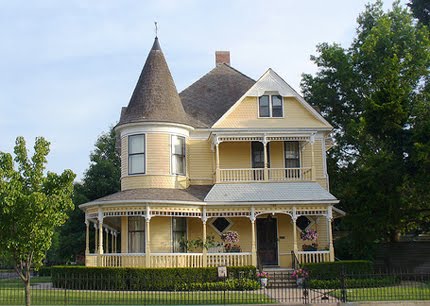
The McMansion recalls the larger homes of the Victorian era, but without the Victorian charm--turrets, bay windows, and those beautiful wrap-around porches--and without all the children. The result, I always felt, was empty space and loneliness for those inside.


The Victorian house, which combines space with coziness in its rooms, lots of windows, additional rooms "outside" on the first-floor porch, and sleeping porches in the back for sleeping outside in the summer.

In the beginning of the 20th century, the Victorian house was on the wane, as the domestic labor market dried up. According to historian Witold Rybczynski in his fascinating book, Home: A Short History of an Idea, homes had to be reduced in size so that one woman could clean them. These were homes for a growing middle class-- growing from people coming in from farms and also immigrants coming up in the world from their start in city tenements. This led to floor plans like that shown here, a home in which there was not a lot of space for guests or family members outside the nuclear family, as in this Sears floor plan.

Modern Home No. 64, from the Sears Modern Home Mail Order Catalogue, 1908 to 1913--a home one woman could keep clean.

I think the shrinkage in homes is all to the good, a downsizing from a prosperity that relied on credit cards; homes seemed to balloon with the debt.

Monday, June 7, 2010

Women in Retail


Here is a painting by the American impressionist painter, Childe Hassam, titled La Bouquetiere and la Latiere. The scene is likely Paris; the year is 1888.

Click on the picture to see it in a larger size.

Here are two women at work. They do not seem at all posed; with their activity or lack thereof and particularly with the nonchalance of the woman in the door of the dairy, this painting could easily be a photograph, taken for instance, by Henri Cartier Bresson. The ladies are completely un-self-conscious of the painter.

This painting reminds us that retail is an arena that has always employed women. I have never come across a book that discusses women's role in the retail trade. Does the woman in the door own the dairy, or does she just work there? Does she have a family to go home to, or does she live above the shop? Is she waiting for someone? Or is it the end of the day, as the dairy jugs in the front of the store might indicate, and is she just standing by the door to stave off boredeom and waiting to go home? Any minute now, we expect her to raise her head slightly, turn around, and go back inside. Meanwhile, the younger woman is arranging flowers and either getting ready for the day or returning from it. She seems unmindful of the dairy seller watching from above.

There is nothing romantic about the women in this painting. Rather, Hassam has painted them with the highest respect.

But the women are also the right and lower side of a triangle with the five dairy jugs, that actually sit in the center of the painting--every day object that one takes for granted but made beautiful with the light reflected off the sloping tops of the jugs. In its spirit, the painting reminds me of Vermeer's The Milkmaid, painting 220 years earlier.


Eight of Hassam's works were shown at the 1913 Armory Show, the first major show of "modern art" in the United States, but Hassam opposed the shift to surrealism and cubism in no uncertain terms and his paintings receded to the background until the interest in the French Impressionists renewed interest in their American counterparts.

Saturday, May 15, 2010

The Cutters


Going and Coming by Norman Rockwell, the cover picture for the latest edition of The Cutters.

The Cutters by Mrs. Bess Streeter Aldrich was recommended as a book that celebrated the domestic arts. Recently I read a quote from Aldrich where she noted that just because a book chronicles the happy part of life does not make it any less valid than those books that chronicle despair. With this prompting I sought to read one of her books and ordered The Cutters.

I found the book to be a bit disappointing, because it seemed like a series of short stories without a centralized plot. I felt that the portrait of the mother was somewhat formulaic--on the one hand, she loves and enjoys her family and her domestic life in a small town, but on the other hand, she constantly yearns to be urbane and sophisticated and to make her name in the wider world. It turns out, since the grass is always greener on the other side, that all of her role models for sophisticated urbanity would rather be like her and have a family and live in a small town.

Thus the book is not exactly a celebration of domestic life, since the mother of the family remains somewhat uncomfortable in this role, or rather feels compelled to reject its joys--as has been the case with many women in modern times. See The Homemaker by Dorothy Canfield for a different exploration of this difficulty.

Where the book shines is in the portrait of the grandmother, a pioneer woman now widowed and living with the family of her son. The chapter on her birthday reunion with all five of her sons and the last chapter in which Mrs. Cutter confronts the reality that her children are all now grown up are, to me, the most profound in the book, because in these chapters, Mrs. Aldrich explores the mysteries of the passage of time, and does it beautifully.

The portrait of the grandmother has made me anxious to read Mrs. Aldrich's novel of a pioneer woman, A Lantern in Her Hand.

Sunday, May 9, 2010

Imagine This: Preparing a Medieval Feast


Whenever I think of feasting, I think of Norman Rockwell's painting, Freedom from Want, and Thanksgiving dinner in the USA. But the large American Thanksgiving family feast is really chickenfeed compared with what I recently read was the norm for the feast in the Middle Ages.

An illustration of a medieval feast in the Les Tres Riches Heures de Duc de Berry.

As reported in Women in the Middle Ages by Marty Williams and Anne Echols:
The amounts and types of foods consumed at banquets seem astounding by modern standards, though we should take note that apparently huge numbers of guests were present on some occasions. At Avignon in the 1340s, Pope Clement VI gave a feast that included approximately 13,000 birds, 1,000 sheep, 50,000 fruit trees, and 200 casks of wine…. Less wealthy individuals rarely had such elaborate feasts or ornamental dishes, but they usually kept amply stocked larders. On an average day—Thursday, August 17, 1413, for example—Dame Alice de Bryene served 146 loaves of bread, one and a half quarters of beef, a lamb, two mutton joints, three quarters of bacon, and 30 pigeons, all washed down with ale and wine. Large quantities of food were necessary because even the lesser nobility rarely dined alone. Alice de Bryene’s household accounts show that on most days her kitchens provided for her large household, several guests, and a number of boon workers—villeins engaged in performing their required days of extra work on their lord’s demesne, the lord’s portion of the manor lands--[or, everyone in the neighborhood-Linda].

For her husband's funeral in 1466, Margaret Paulson, the widow of a wealthy merchant, cooked up a spread with 41 pigs, 1,000 eggs, 49 calves, a great number of chicken and geese, and a large quantity of beer.

This gives you an idea of the huge number of guests at the medieval dinner table, which on big holidays might bring together all the on the manor.

Kirstin Lavransdatter, by the Nobel Prize-winning Norwegian writer Sigrid Undset, gives a good idea of the many duties of the medieval "lady of the manor," who worked hard and often ran the manorial agricultural and industrial enterprise alone when the husband was away to war. Kirstin Lavransdatter is a trilogy of three books--I had to read to the end of the last one to fully appreciate this wonderfully told story of a medieval wife and mother. My mother introduced me to Kirstin Lavransdatter--it was her favorite book.

Saturday, May 1, 2010

Has Mending Ever Been So Elegant?


Mending, Edmund Tarbell, 1910

Three years before the International Exposition of Modern Art—the famous “Armory Show”—in Chicago, which introduced the United States to 634 works from Goya to the Cubists, Edmund Tarbell painted Mending. Tarbell, as did many American artists, resisted the turn to abstract art and continued to paint interiors reminiscent of Vermeer and the painters of the Dutch Golden Age. Tarbell's interiors were those of New England--sparse, restrained, not particularly comfortable, but elegant.

I don't like to mend at all but this painting might inspire me to. Nowadays, inundated with relatively cheap clothing, when something rips or tears, we replace it; we don't mend it. But mending used to have its own entire day in the housewives' weekly calendar:
Wash on Monday
Iron on Tuesday
Mend on Wednesday
Churn on Thursday
Clean on Friday
Bake on Saturday
Rest on Sunday

Clothes were worn til they literally wore out, and then the remaining cloth was recycled into quilts and other items.

Here we see someone who is clearly not of the working class doing her mending with considerable concentration. The composition draws us immediately to the girl's face. As is often the case, the painting of a woman sewing is also a painting of a individual in contemplation, deep in thought, either about the problem at hand or about something else that we cannot know.

Meanwhile, the light falls upon her and the room from the window at the left. Tarbell himself is concentrating on capturing the play of light bouncing off objects of color and the color this creates in the air. With the exception of the girl's black skirt and the black table legs, no part of the paint surface is purely the same color. The painting is in constant motion, as color shifts from one hue to another and into the next color.

The light also halos the head of the subject and is how we are drawn to her face in concentration.

Wednesday, April 21, 2010

Books in the House Benefit Children, Study Shows


Nurse Reading to a Little Girl, Mary Cassatt, 1895

A fascinating international study shows that children who grow up in homes that have home libraries are much more likely to do well in school. The study encompassed 27 countries. “Home library size has a very substantial effect on educational attainment, even adjusting for parents’ education, father’s occupational status and other family background characteristics,” reports the study, recently published in the journal Research in Social Stratification and Mobility. “A child from a family rich in books is 19 percentage points more likely to complete university than a comparable child growing up without a home library.”

As noted by a report on the study by Tom Jacobs: "This effect holds true regardless of a nation’s wealth, culture or political system, but its intensity varies from country to country. In China, a child whose parents own 500 books will average 6.6 more years of education than a comparable child from a bookless home. In the U.S., the figure is 2.4 years — which is still highly significant when you consider it’s the difference between two years of college and a full four-year degree."

This research relates somewhat to my hunch that the higher the quality of books a child reads the more productive they may be in later life.

You can read the abstract of the home library study here, and I first learned about it here.