Showing posts with label Women and Christianity. Show all posts

Monday, April 20, 2020

Titian's Supper at Emmaus

Supper at Emmaus, Titian, 1530, The Louvre

The great Venetian Renaissance artist,Tiziano Vecelli, known as Titian, in 1530 painted this beautiful evocation of the Supper at Emmaus, as told in Luke 24:13-35. 

The Story
The story in the Gospel of Luke is prefaced by the words of the women, telling the disciples what they had seen and heard at the tomb of the risen Lord that Easter morning, but “…these words seemed to them”—to the disciples—“an idle tale, and they did not believe them.

“That very day two of them were going to a village named Emmaus, about seven miles from Jerusalem, and talking with each other about all those things that had happened. While they were talking and discussing together, Jesus himself drew near and went with them. But their eyes were kept from recognizing him” [emphasis added]. 

The two disciples and the stranger continue to walk together, and the disciples tell him of what has happened to Jesus of Nazareth and how “our chief priests and rulers delivered him up to be condemned to death, and crucified him.” They relate how it is now the third day since Jesus died, and that some of the women “were at the tomb early in the morning and did not find his body; and they came back saying that they had even seen a vision of angels, who said that he was alive. Some of those who were with us went to the tomb, and found it just as the women had said; but him they did not see” [emphasis added].

Christ gently chastises his two disciples, saying, “‘O foolish men, and slow of heart to believe all that the prophets have spoken! Was it not necessary that the Christ should suffer these things and enter into his glory?’ And beginning with Moses and all the prophets, he interpreted to them in all the scriptures the things concerning himself.” 

As they near Emmaus, the disciples ask him to stay with them, rather than go on alone, “ ‘for it is toward evening and the day is now far spent.’ So he went in to stay with them. When he was at table with them, he took the bread and blessed, and broke it, and gave it to them. And their eyes were openedand they recognized him; and he vanished out of their sight” [emphasis added].

Many years later Pope Gregory the Great (540-604), revered as the father of Christian worship, preached on the Supper at Emmaus (Homily 23 in his Homilies on the Gospels). The two disciples on the road to Emmaus “did not, in fact, have faith in him, yet they were talking about him. The Lord, therefore, appeared to them but did not show them a face they could recognize. In this way, the Lord enacted outwardly, before their physical eyes, what was going on in them inwardly, before the eyes of their hearts. For inwardly they simultaneously loved him and doubted him; therefore the Lord was outwardly present to them, and at the same time did not reveal his identity. Since they were speaking about him, he showed them his presence, but since they doubted him, he hid from them the appearance by which they could have recognized him.” 

The Painting
Titian paints the moment when the disciples suddenly realize that the stranger in their midst is Christ. Christ’s left hand is on the bread, and he raises his right hand in the gesture of blessing. At this moment, the disciple on the right—dressed as a contemporary Italian friar—brings his hands together and partially rises, perhaps to fall to his knees before Christ. The other disciple draws back in consternation. 

The moment of recognition comes just as Christ repeats the blessing and giving of the bread, as in the Last Supper that initiated the Eucharist. Titian draws upon  Leonardo da Vinci’s The Last Supper, painted in the 1490s: a long frontally positioned table covered in white linen with Christ in the center flanked by his disciples, all of whom have highly individual reactions to Christ’s blessing of the bread. 


The Last Supper, Leonardo da Vinci, 1495

It is noted by art historians that the disciple to the left in Titian’s painting has a pose closest to that of Judas in Leonardo’s painting—a posture of withdrawal from the figure of Christ. At first I didn’t think this could be, but the half-medallion on the wall behind this disciple has the vague outlines of the torso of a hanging person, dressed in 16th-century garb, and a hook hangs from this medallion, while immediately to the right in sketchy white are what seem to be the shapes of a ribcage and perhaps a skeleton head. If this is at all a correct reading of this object in the upper left of the painting, then it is likely that there lies the shadow of death, Judas’ death in particular, in contrast to Titian’s celestial coloring of Christ, signifying the triumph over death. 

Christ’s face, at the horizontal center of Titian's painting, has a serene, other-worldly quality—it is bathed in light and his downcast eyes, as in Leonardo’s painting, suggest a humility that is turned to that which is unseen. His face is in keeping with the sacramental actions of his hands. The friar to his right looks of this world, but his humility in pressing his hands together as in prayer and his positioning as if about to kneel before the now-recognized Lord, show his love of Christ and his own nascent holiness. 

Leonardo’s famous painting situates the Last Supper before a trinity of windows opened to distant views of hills and sky. Titian’s single window opens up to a fully painted landscape and sky. The single tree stands as a remembrance of the wooden cross upon which Christ had died. (The tree seems slight, but alive, compared with the adjacent monumental Roman column behind Christ.) To the right, the earthen colors of the mountain continue into the brown cassock of the friar, and the beautiful blue, pale violet, and grays of the more distant mountain and sky are echoed in Christ’s gown and mantle. Titian chose to paint a sky in which the sun is unseen, but its light comes from behind gray storm clouds against an ascending sky of clear blue—a metaphor of light for the emotion evoked by the story itself. Titian’s unity of color signifies the harmony of Christ, God’s natural order, and the followers of Christ. 

On the other side of the painting are more secularized individuals. The innkeeper has no awareness of or interest in the emotional tumult caused by the disciples’ realization that Christ is present. The innkeeper’s face is turned away, and his left hand sports a large ring of gold, perhaps pointing to the subject of his thoughts. Judas’s left hand, palm up, is immediately under the innkeeper’s hands. 

Under the table a dog growls at a cat. In medieval and renaissance Christianity, dogs symbolized loyalty, watchfulness, and trustworthiness—not like the disciples that slept as Christ prayed in Gethsemane although he had asked them to watch, or like Saint Peter, who denied Christ three times, as Christ told him he would do—loyalty, watchfulness, and trustworthiness in contrast to fallen man. The cat often symbolized cunning and deceit, such as in the betrayal of Judas, sitting directly above. 

The most diminutive figure is that of the adolescent servant bearing food, who looks beyond Judas to the friar at the far side of the table but with no apprehension of what is taking place. His innocent interest, however, brings him far closer to Christ than the complacency of the oblivious innkeeper. 

In all figures, Titian has painted hands that speak volumes of the inner life of their owners. The boy’s hands show a delicacy and tenseness of expectation and willingness to serve. Judas’ hands demonstrate his extreme surprise in seeing Christ, whom he had helped bring to what he believed would be certain death. The innkeeper’s hands, with his thumbs hooked in his belt, point to his earth-bound nature. Christ’s hands are carefully positioned in sacramental action, with the fingers of his blessing hand gracefully arched. The friar’s hands are those of one in prayer—any surprise he feels at his recognition of Christ is superseded by his humble desire to worship his Savior.

A striking feature of Titian’s painting is the prominence of the starched pure white tablecloth that stretches across the composition and touches all figures. Leonardo’s Last Supper table also has a white cloth with its fold lines, but our eyes quickly pass it by to look at the action above. In Titian’s painting, the white cloth is a symbolic reminder of the white linen burial shroud that enfolded Christ in burial and also of the white cloth laid out on a Christian altar. And this crisp, beautiful linen also brings to the mind the unseen women, who washed, starched, folded, and laid it—women such as those who loved Christ and first received the news that he had risen, and believed.

Wednesday, March 11, 2020

Saint Sebastian Tended by Saint Irene: An Image for Our Times


Saint Sebastian Tended by Saint Irene, by Hendrick Jansz Terbrugghen, 1625, Utrecht, The Netherlands

Saint Sebastian (256-288) was a Christian martyr who was tied to a post in Diocletian's Rome and shot through with arrows as punishment for his refusal to renounce his Christian faith. He did not die, however, thanks to Saint Irene, the widow of another martyred Roman Christian, who came to cut  down Sebastian from the post and bury him. Finding him still alive, she brought him to her home and nursed him to health.

The 17th-century Dutch artist Terbrugghen (1588-1629) paints the moment when Saint Irene and her servant rush to free Saint Sebastian and begin attending to his wounds. The painting, nearly 5 feet by 4 feet, is among the treasures at the Allen Memorial Art Museum in Oberlin, Ohio.

Terbrugghen was one of a group of Dutch painters who lived and painted in Italy, learning fluidity of form and drama from the paintings of Michelangelo Caravaggio (1571-1610). After seven years in Rome, Terbrugghen returned to his native city of Utrecht in 1614.

In the late Middle Ages, the arrows that pierced the body of Saint Sebastian became a metaphor for the fatal piercing of the flesh by the bubonic plague--the disease of the Black Death that ravaged Europe in the 14th century and continued to recur regularly in European cities. For this reason, Saint Sebastian is venerated by the faithful as a protector against the plague.

Saint Sebastian's protection was immediately relevant to the inhabitants of Terbrugghen's Utrecht, where the dreaded disease returned each summer from 1625 to 1629. Terbrugghen brings this home in two ways.

First, as Valerie Hedquist points out in an article for the Journal of Historians of Netherlandish Art (Volume 9, Issue 2 Summer 2017), the painter adds buboes on the body of the dying Saint Sebastian--on the inside of his right elbow and prominently on his right knee. He also shows the blackening of the saint's skin from the internal hemorrhaging the disease causes. The metaphor is now the reality.

Second, Terbrugghen heightens the immediacy of the drama by placing us so close to the life-sized figures. Saint Sebastian's right knee juts out beyond the picture plane, putting us right into the scene and drawing us upward toward the expressions of urgency and care in the faces of the saint's rescuers. As the art historian Wolfgang Stechow writes,
"... the action of the two women is the very life-blood of the picture. Loving care is about to conquer death; it is a tense struggle but it is a noiseless one. No punches are pulled in the depiction of the nearness of the end: the body of Sebastian is olive-grey, his mouth drooping, his left arm hangs limp, touching the ground behind his right foot. Yet the activity of the women bespeaks efficient help--but without resort to any ado. Wonderful is the quiet contrast between the neighboring hands at the upper left, and particularly, how the lifeless flesh of Sebastian's right hand yields to the pressure with lively resilience. It is as though this contrast sounded the key for the entire picture. Above the slumping head of the Saint appear the reassuring smile of Irene and the busily alert profile of her servant. The lifting of the arrow by Irene's gentle right hand is a masterpiece of depicting an action bent upon easing pressure and soothing pain, her left hand is a little wonder of subtle luminosity (The Burlington Magazine, Vol. 96, No. 612, March 1954).  
Almost 400 years later, Terbrugghen's masterpiece prompts the modern-day viewer to pause and consider the courage of our first responders and hospital doctors and nurses as they act with all due haste to care for those sick with infectious disease.

Tuesday, January 19, 2016

Saint Sebastian and a First Responder

January 20 is the feast day of Saint Sebastian, who died in 288 at the hands of the anti-Christian Roman emperor, Diocletian. Saint Sebastian was a member of the Roman emperor's Praetorian Guard, but when it was discovered that he was a Christian, he was delivered for persecution to archers from Mauritania and was riddled with arrows, as shown in this painting by the great Italian Renaissance painter, Andrea Mantegna.


Saint Sebastian by Andrea Mantegna, 1480

When we see this painting of Saint Sebastian we assume that this is how he became a Christian martyr. But in fact he survived this torture, because Saint Irene, the widow of the Christian martyr Saint Castulus, rushed to his aid. 


Saint Irene Coming to the Aid of Saint Sebastian by Trophime Bigot (1579-1650)


Saint Sebastian Aided by Saint Irene by Georges de la Tour, 1650

Saint Sebastian did not die of the "slings and arrows of outrageous fortune," because Saint Irene removed the arrows, took him home, and nursed him back to health. After he had recovered, Saint Sebastian openly confronted the Emperor Diocletian, calling upon him to stop his persecution of Christians. The emperor responded by ordering that Saint Sebastian be placed under immediate arrest and be bludgeoned to death. This time Diocletian succeeded. 

It is believed that Saint Sebastian is a protector against the plague, and he is the patron saint of athletes and soldiers. Saint Irene's feast day is March 30. 


Sunday, August 11, 2013

For From the Lap of the Mother...


Madonna del Libro by Sandro Botticelli, 1483

A statue of the Madonna and Child in the Church of Badia in Sansepolcro, Italy, has an inscription under it that says:

"From the lap of the mother shinest the wisdom of the Father."

I could not find a photograph of this statue, so turned to Botticelli for help to illustrate this beautiful thought.

I learned about the statue in Richard Cork's The Healing Presence of Art: A History of Western Art in Hospitals.

Friday, January 6, 2012

Wednesday, January 4, 2012

Saint Elizabeth Ann Seton


"We must pray literally without ceasing—without ceasing—in every occurrence and employment of our lives . . . that prayer of the heart which is independent of place or situation, or which is rather a habit of lifting up the heart to God as in a constant communication with Him."--Elizabeth Ann Seton


Today is the feast day for Saint Elizabeth Ann Seton (1774-1821), the first person born in the United States to be canonized by the Catholic Church (1975). She is the patron saint of Catholic schools.

Born in New York to a prominent Episcopalian family, Elizabeth Ann Seton was left motherless at the age of three. Even as a child, she was dedicated to Christianity, wearing a small crucifix around her neck and taking delight in reading the Psalms. Psalm 23 remained her favorite prayer throughout her life. When she was 19 years old, Elizabeth married a New York businessman, to whom she was devoted. The couple had five children. Despite her many household duties, she found time to organize prominent women in New York City to visit the sick poor in their homes and bring them and their families sustenance. Inspired by the work of Saint Vincent de Paul, the group was called informally the "Ladies of Charity."

In December 1803, Elizabeth Ann Seton was widowed and lived for a period of time in Rome with the Italian family of her husband's business partner. Here she was introduced to the Catholic faith, and in March 1805 was received into the church, amid the protests of her family and friends. Faced with the necessity to support her children, Mrs. Seton sought teaching positions. In 1809, after several difficult years, she accepted the invitation of the Sulpicians Order to teach in Emmitsburg, Maryland. Here she founded the Saint Joseph's Academy and Free School for the education of Catholic girls, the first such school in the United States. She also established a religious community in Emmitsburg dedicated to the care of the children of the poor. She died at the age of 46 of tuberulosis, having already buried two of her daughters.

You can get a glimpse of the soul of this saint in the book Elizabeth Seton: Selected Writings edited by Ellin Kelly and Annabelle Melville. Here is a benediction that she wrote toward the end of her life:
Mary Queen and Virgin pure!--as poor unfledged Birds uncovered in our cold and hard nests on this Earth we cry to her for her sheltering outspread wings--little hearts not yet knowing sorrow--but poor tired and older ones pressed with pains and cares seek peace and rest--O our Mother! and find it in thee.--

Monday, January 2, 2012

Saint Genevieve of Paris


Saint Genevieve by Hugo van der Goes, 1479

Women saints are exemplars of faith whose charitable work often resulted in the creation of new institutions and new precedents that changed the course of history. Saint Genevieve (420-502), the Patron Saint of Paris, was one of these saints, and January 3 is her feast day.

This faith-fueled woman is a saint for our time, especially because she appears to have been mentored by Saint Germanus (378-448), Bishop of Auxerre, who led the Church's fight against the Pelagian heresy in Britain at the behest of Pope Saint Celestine I. Pelagius (354-420) believed that man can be sinless and good all on his own and has no need of God's grace. The story goes that on his way to Britain in 429, Germanus stopped in Nanterre, France, where Genevieve, a young girl born of well-to-do parents, confided to him that she wanted to live only for God. Germanus encouraged her and sent her the veil of a dedicated virgin. When Genevieve's parents died when she was 15, she went to live with her godmother in Paris, where she devoted her days to prayer and charity and was reportedly visited again by Germanus.

Her life of devout piety though is not why Genevieve is the patron saint of Paris. In a foreshadowing of the peasant military heroine, Saint Joan, Saint Genevieve is credited with averting the destruction of Paris--twice. The first time was in 451, when the ferocious Attila the Hun was on a course straight for Paris. Genevieve told the terrified Parisians not to flee the city but to remain in their homes, fast, and pray, and she organized a prayer marathon. Abruptly Attila changed course, leaving Paris intact. The second time was when invading Franks had blockaded the city in 464. Genevieve ran the blockade to bring food to the starving Parisians. Later she pleaded successfully for Parisian prisoners of war to the Frankish King Childeric, and King Clovis liberated captives at her urging.

Hugo van der Goes painted Saint Genevieve on the outer panel for a diptych that depicted the Fall of Man on one side and the Redemption (the Lamentation of Christ) on the other, indicating the high esteem either he or his patrons (or both) had for Saint Genevieve 1,000 years later. She is also considered a patron saint of young girls.

Sunday, November 27, 2011

First Sunday of Advent: Prepare Ye the Way of the Lord


Saint Columba Altarpiece by Rogier van der Weyden, 1455.

Luke 1:26 to 38

And in the sixth month the angel Gabriel was sent from God unto a city of Galilee, named Nazareth, 27 To a virgin espoused to a man whose name was Joseph, of the house of David; and the virgin's name was Mary. 28 And the angel came in unto her, and said, Hail, thou that art highly favoured, the Lord is with thee: blessed art thou among women.

29 And when she saw him, she was troubled at his saying, and cast in her mind what manner of salutation this should be.

30 And the angel said unto her, Fear not, Mary: for thou hast found favour with God. 31 And, behold, thou shalt conceive in thy womb, and bring forth a son, and shalt call his name JESUS. 32 He shall be great, and shall be called the Son of the Highest: and the Lord God shall give unto him the throne of his father David: 33 And he shall reign over the house of Jacob for ever; and of his kingdom there shall be no end.

34 Then said Mary unto the angel, How shall this be, seeing I know not a man?

35 And the angel answered and said unto her, The Holy Ghost shall come upon thee, and the power of the Highest shall overshadow thee: therefore also that holy thing which shall be born of thee shall be called the Son of God. 36 And, behold, thy cousin Elisabeth, she hath also conceived a son in her old age: and this is the sixth month with her, who was called barren. 37 For with God nothing shall be impossible.

38 And Mary said, Behold the handmaid of the Lord; be it unto me according to thy word. And the angel departed from her.

Saturday, January 8, 2011

"An Ordered Plan of Love"

Karin Larsson, by Carl Larsson, 1909

The genesis of this blog was a search on the Internet to investigate the effects on children of a physically and emotionally chaotic home, which led to Homeliving Helper and eventually to Under the Gables.

However, none of the explanations I read about the importance of maintaining a loving and clean and orderly home for children was satisfying. But at last, in Lift Up Your Hearts to Mary, Peace, Prayer, Love, by Caryll Houselander, I have found an explanation that makes complete and perfect sense to me. Here is what this most poetic writer says in her essay, "The House on the Rock," in this book:
To a young child home stands for God. In it he learns to see and touch the gifts of God. If his mother is wise she will make his home beautiful. She will copy the world's creator and make a tiny new Eden. She will bring in flowers and give the child animals and feed the birds. The food on the table will be clean and simple and good. It will not only taste nice, it will look nice....

It is in his home that the child should assimilate the Sermon on the Mount, not as if it were being drilled in his brain by words, but as if he were breathing it in his whole being like the air....

The ordering of time, which seems so simple, really requires great skill and energy from the mother. It has tremendous importance, above all if it is related (as it obviously should be) to the rhythm of day and night and is interwoven with prayer.

The child should wake to the singing of the birds (and they sing in the cities as well as in the woods). Give his heart to God, when light is young, play for long hours when the world is awake and lively. He should form habits of regular hunger and thirst, so that food and hunger come together, and his grace is a real thanking. With twilight there should come stillness in the house and he should be lit to bed by the stars.

From such ordering of time he will learn unconsciously, though it may be years before he thinks this out, that he is not part of that chaos that man has made of this world, with its fearful abuse of time, but part of an ordered plan of love.


Illustration for her book Bright April by Marguerite di Angeli.

Wednesday, December 29, 2010

Christmas


The Newborn, by Georges de la Tour, 1645

"What we shall be asked to give is our flesh and blood,
our daily life -- our thoughts, our service to one another,
our affections and loves, our words, our intellect, our waking, working, and sleeping,
our ordinary human joys and sorrows -- to God.
To surrender all that we are, as we are, to the Spirit of Love
in order that our lives may bear Christ into the world -- that is what we shall be asked."

- Caryll Houselander
via Heimatland

Monday, November 8, 2010

Preparing for Advent


Advent begins on Sunday, November 28, and it may seem strange to talk about preparing for a season that is itself all about preparation, but that is how the British writer, poet, and Catholic mystic, Caryll Houselander, begins her beautiful treasure, The Reed of God, written in 1944:

That virginal quality which, for want of a better word, I call emptiness is the beginning of this contemplation.

It is not a formless emptiness, a void without meaning; on the contrary it has a shape, a form given to it by the purpose for which it is intended.

It is emptiness like the hollow in the reed, the narrow riftless emptiness which can have only one destiny: to receive the piper's breath and to utter the song that is in his heart.

It is emptiness like the hollow in the cup, shaped to receive water or wine.

It is emptiness like that of the bird's nest, built in a round warm ring to receive the little bird.

The pre-Advent emptiness of Our Lady's purposeful virginity was indeed like those three things.

She was a reed through with the Eternal Love was to be piped as a shepherd's song.

She was the flower-like chalice into which the purest water of humanity was to be poured, mingled with wine, changed to the crimson blood of love, and lifted up in sacrifice.

She was the warm nest rounded to the shape of humanity to receive the Divine Little Bird.

Emptiness is a very common complaint in our days, not the purposeful emptiness of the virginal heart and mind but a void, meaningless, unhappy condition.

Strangely enough, those who complain the loudest of the emptiness of their lives are usually people whose lives are overcrowded, filled with trivial details, plans, desires, ambitions, unsatisfied cravings for passing pleasures, doubts, ambitions, unsatisfied cravings for passing pleasures, doubts, anxieties, and fears; and these sometimes further overlaid with exhausting pleasures which are an attempt, and always a futile attempt, to forget how pointless such people's lives are. Those who complain in these circumstances of their lives are usually afraid to allow space or silence or pause in their lives. They dread space, for they want material things crowded together, so that there will always be something to lean on for support. They dread silence because they do not want to hear their own pulses beating out the seconds of their life, and to know that each beat is another knock on the door of death. Death seems to them to be only the final void, the darkest, loneliest emptiness.

They have no sense of being related to any abiding beauty, to any indestructible life: they are afraid to be alone with their unrelated hearts.

Such emptiness is very different from that still, shadowless ring of light round which our being is circled, making a shape which in itself is an absolute promise of fulfillment.

The question which most people will ask is: "Can someone whose life is already cluttered up with trivial things get back to this virginal emptiness?"
Of course he can: if a bird's nest has been filled with broken glass and rubbish, it can be emptied.

It is not only trivialities which destroy this virgin mindedness; very often, serious people with a conscious purpose in life destroy it by being too set on this purpose. The core of emptiness is not filled by trifles but by a hard block, tightly wedged in. They have a plan, for example, for reconstructing Europe, for reforming education, for converting the world; and this plan, this enthusiasm, has become so important in their minds that there is neither room to receive God nor silence to hear His voice, even though He comes as light and little as a Communion wafer and speaks as soft as a zephyr of wind tapping on the window with a flower.

Zealots and triflers and all besides who have crowded the emptiness out of their minds and the silence out of their souls can restore it. At least, they can allow God to restore it and ask Him to do so.

The whole process of contemplation through imitation of Our Lady can be gone through, in the first place, with just the simple purpose of regaining the virgin-mind, and as we go on in the attempt we shall find that over and over again, there is a new emptying process; it is a thing which has to be done in contemplation as often as the earth has to be sifted and the field ploughed for seed.

At the beginning it will be necessary for each individual to discard deliberately all the trifling unnecessary things in his life, all the hard blocks and congestions; not necessarily to discard all his interests for ever, but at least once to stop still, and having prayed for courage, to visualize himself without all the extras, escapes, and interests other than Love in his life: to see ourselves as if we had just come from God's hand and had gathered nothing to ourselves yet, to discover just what shape is the virginal emptiness of our own being, and of what material we are made.

We need to be reminded that every second of our survival does really mean that we are new from God's fingers, so that it requires no more than the miracle which we never notice to restore us to our virgin-heart at any moment we like to choose.

Our own effort will consist in sifting and sorting out everything that is not essential and that fills up space and silence in us and in discovering what sort of shape this emptiness in us is. From this we shall learn what sort of purpose God has for us. In what way are we to fulfill the work of giving Christ life in us?

Are we reed pipes? Is He waiting to live lyrically through us?
Are we chalices? Does He ask to be sacrificed in us?

Are we nests? Does He desire of us a warm, sweet abiding in domestic life at home?
These are only some of the possible forms of virginity; each person may find some quite different form, his own secret.

I mention these three because they are all fulfilled in Our Lady, so visibly that we may be sure that we can look at them in her and learn what she reveals through them.


If you would like to read more writings of Caryll Houselander, many of her books are available at Albris, Barnes and Noble, and Borders.

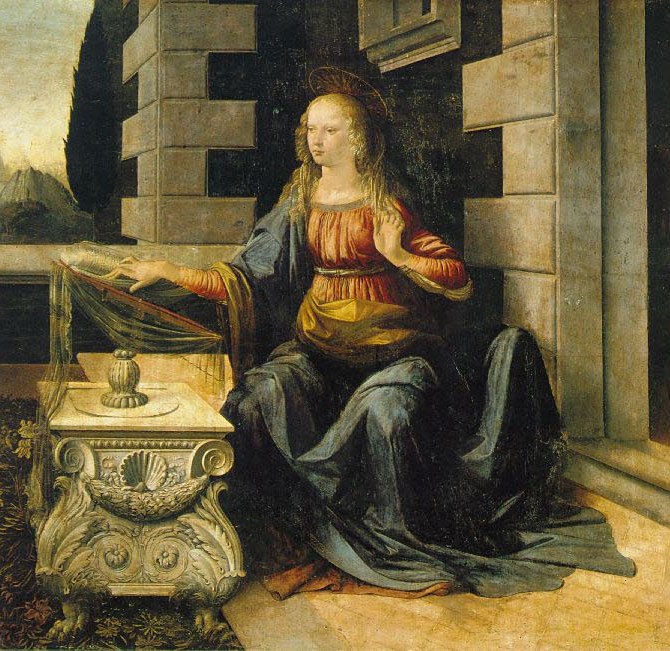
The painting is The Annunciation by Leonardo da Vinci, 1472-75.

Monday, July 12, 2010

Creating a Mary Garden


In this medieval painting Mary gives the Baby Jesus a flower. Strawberries, signifying Fruitful Virgin, grow in the raised garden behind them.

(I realize this is a little late, but consider it early for next spring!)

The Mary Garden is a tradition from the Middle Ages, when gardens were created with flowers and shrubs that all signify names of the Virgin Mary or her attributes. Medieval gardens were usually small and enclosed and featured trellises like the one in the painting above.

If you have a garden, most likely numbers of the flowers and shrubs you have planted signify names of Mary or her attributes, such as humility (violet) and purity (lily), or also her eyes (forget-me-nots) or her heart (begonia), or even an event like Easter (forsythia, known as the Easter Bush), the Flight into Egypt (lavender), or a Lenten rose.


A Mary garden in Australia, compliments of Under Her Starry Mantle.

A Mary Garden gives praise to Mary and also invites us to contemplation, especially if it is centered around a statue of Our Lady. Mary gardens are traditionally enclosed. But even if you are not able to strictly create a Mary garden, it is a lovely thought to know the religious meanings of the plants that you may already have. In my garden, for instance, I have hydrangeas and was very happy to learn that they mean Ave Maria. They sit next to forsythia, the Easter Bush, and a rose bush, meaning Mary's Glory, and in front I have petunias (Lady's Praise).

To learn all about Mary gardens, you can go here and here and to see a beautiful Mary garden in Annapolis, go here.

Friday, July 9, 2010

Fine Arts Friday: Mary's Flowers in the Portinari Altarpiece


Still Life in the center of the Portinari Altarpiece by Hugo van der Goes, 1476-1479.

Flowers, in two vases next to a wheat chaff and surrounded by strewn violets, form the lower section of the frame for the image of the Infant Christ in this large triptych that now resides at the Uffizi Museum in Florence, Italy. The iconography of this still life points to the underlying theme of this Nativity scene: the Virgin Mary and her relationship to Christ and Christ's relationship to us through His Passion.

The exquisitely painted flowers each have a meaning:
The lily was a symbol of Mary and her purity. The stalk represented her religous mind, the leaves her humility, and the flower her mercy. The lily, it was believed in the Middle Ages, had first grown from tears that Eve shed as she fled the Garden of Eden. There are two lilies here on one stalk, with the number two signifying Christ's dual human and godly nature.

Also in the vase are three irises, white and blue for purity and heavenliness and three perhaps for the theological virtues of faith, hope, and charity. The iris was itself a symbol of light and hope, but its leaves, seven in number here, signify the seven sorrows of Mary:
The Prophecy of Simeon over the Infant Jesus. (Gospel of Luke 2:34)
The Flight into Egypt of the Holy Family. (Gospel of Matthew 2:13)
The Loss of the Child Jesus for Three Days. (Luke 2:43)
The Meeting of Jesus and Mary along the Way of the Cross. (Luke 23:26)
The Crucifixion, where Mary stands at the foot of the cross. (Gospel of John 19:25)
The Descent from the Cross, where Mary receives the dead body of Jesus in her arms. (Matthew 27:57)
The Burial of Jesus. (John 19:40)

The columbine in the clear glass, with the light shining through in the left of the glass, symbolizes the Holy Spirit, or the Divine Spouse.

The three carnations peeking out over the rim of the glass symbolize love, and their number symbolizes the Trinity. It was believed that the carnation first grew from the tears of Mary for Christ.

The violets symbolize faithfulness, humility, and chastity.

The meanings of these beautifully rendered flowers are part of the great symphony of van der Goes' painting, to which we are called as participants.

Portinari Altarpiece central panel.

The wheat chaff and the liturgical garb of some of the angels point to the Eucharist, in which we partake of the body and blood of our Lord Jesus Christ, who sacrificed his life for our sins in the Passion. The Passion is the invisible theme of the painting, as shown in the solemn visage of Mary, who foresaw Christ's Passion from the beginning, and the pious stance of Saint Joseph and the angels, as if in preparing to receive Holy Communion. The empty shoe before Joseph is a reminder of God's words to Moses on Mount Sinai before the burning bush: Put off your shoes from your feet, for the place you are standing is holy ground."

Nevertheless, even though this painting is "hallowed ground," we, like the shepherds, are invited to join in this scene, which is not at our eye level or above us, but is slanted toward us, a beckoning to bear the sorrows of Mary for her Son and to join in the sacrifice of the Eucharist.

You can see all panels of the Portinari Altarpiece here. Van der Goes painted the altarpiece in Flanders on commission for the Sant d'Edigio chapel in the Santa Maria Nuova Hospital in Florence, Italy.

Wednesday, March 31, 2010

Good Friday


The Crucifixion, with the Virgin and Saint John the Evangelist Mourning by Rogier van der Weyden, 1460-65.

From the Philadelphia Museum of Art: Handbook of the Collections (1995), p. 167.
by Katherine Crawford Luber, 1995:

The greatest old master painting in the Museum, Rogier van der Weyden's diptych presents the Crucifixion as a timeless dramatic narrative. To convey overwhelming depths of human emotion, Rogier located monumental forms in a shallow, austere, nocturnal space accented only by brilliant red hangings. He focused on the experience of the Virgin, her unbearable grief expressed by her swooning into the arms of John the Evangelist. The intensity of her anguish is echoed in the agitated, fluttering loincloth that moves around Christ's motionless body as if the air itself were astir with sorrow. Rogier's use of two panels in a diptych, rather than the more usual three found in a triptych, is rare in paintings of this period, and allowed the artist to balance the human despair at the darkest hour of the Christian faith against the promise of redemption.

I only add to Ms. Luber's beautiful discussion that the duality of the two sides of the diptych, with the overwhelming emotion in Mary on one side, and the austere presentation of the suffering Christ on the other, is not total but is broken by the small piece of Mary's garment that slips to the other side.

You can see this painting in the Philadelphia Museum of Art, where its presence dominates the Medieval section of the museum.

Thursday, February 18, 2010

After This by Alice McDermott: Faith and Family

A few years ago I read a review of a book by Alice McDermott, who was presented as a Catholic writer raised in Long Island. The book was about family life. I clipped the article with the idea of finding the book and reading it. I lost the clipping but never forgot it. I held in my memory this picture of the author:

Alice McDermott

Old-fashioned hair cut, sad eyes, but with a knowing and contented smile, someone who had taken life in and accepted all its gifts and disappointments. Not remembering the name of the book or the author, I tried to search on the web with various keywords to see if I could find the author and her book. To no avail. Then one day, I found Catholic Fiction and bumped right into her. I recognized that picture and made a beeline to the library to find her books.

After This is Alice McDermott’s story of a family that starts out in the years after World War II and whose children come of age in the tumultuous and perilous times of the late 1960s. The book is suffused with the humility reflected in the eyes of Mrs. McDermott herself. We are not talking about historical figures or even upper-middle-class "Ordinary People," but of real ordinary people, who struggle to build a family and a scrape a living together in a Long Island suburb of diminutive small homes.

A street in postwar Levittown, New York: a street that I imagine was similar to the setting for After This.

In part the book shows how these people were ravaged by the seismic changes in their culture: a son goes to Vietnam to prove himself as a man and becomes a martyr to his own goodness and fears. Of the daughters, one is overseas and lives with a man, another becomes pregnant and wrestles with her Catholic conscience. All of these vital issues are presented sotto voce, so to speak.

What I liked about After This was this: the story is infused with history — those events that always seem beyond our control but affect our lively so profoundly — and with liturgy and prayer.

For history, for example:When John and Mary Keane, the parents, said "during the war," that is, World War II,
their children imagined the world gone black and white, imagined a hand passing like a dark cloud over the earth, blotting out the sun for what might only have been the duration of a single night, or the length of a storm. Long before any of them was born, after all, their parents, the world itself, had emerged from that shadow.
Is this not the shadow that haunted the world long after the war had been won. Had the war been won truly in the heart of man?

And for liturgy: In the midst of a hurricane, after the electricity goes out, the family goes down to the basement:
Their mother patted Jacob’s hand to soothe him. On their way through the kitchen she took a bottle of milk from the refrigerator and the remaining paper cups from their picnic. They followed their father’s flashlight down the wooden steps. … They sat together on the old could that was just the other side of the toy-train table. Their mother between the two boys to avoid trouble, Annie on her father’s lap. The washing machine and the sink and the long string of the clothesline where she hung clothes in bad weather were just behind them, each illuminated, however dimly, by the blue light of the storm at the narrow windows. Around their own circle of light, their mother said, “Let’s say an Angel of God,” the bodies of her two boys pressed against her. “Angel of God,” they said, following her voice, “My guardian dear, to whom God’s love, commits me here, ever this night, be at my side, and guard, to rule and guide. Amen.”


Catholic religious card with guardian angel guiding two children across a broken bridge.

Such interpolations of liturgy appear throughout the book, letting us know that, especially within the mother, another world is always at hand to give strength for the survival of the soul in this one.

My problem with the book is only this: it is way too short. The most vivid characters are the children, whereas the characters I was most fascinated with were the parents. I wanted to know everything about what made them tick, who they were, and what they thought of every moment described and of their own past moments. Most especially I wanted to know far more profoundly the feelings of the mother, which I knew were complicated but possessing a goodness that softened the harsh edges of a sometimes disappointing life. I felt that the book was character-dispersed.
But that greedy complaint does not take away from the fabric of the book itself. God’s love is truth that rescues our souls from the follies of man. The echoes of prayer and liturgy throughout the book remind the readers, as it reminds the characters, of this loving truth.

You can read interviews with Alice McDermott in the Washington Post here and here. Articles on Alice McDermott can also be found in the New York Times.

Wednesday, February 10, 2010

Smithsonian Celebrates Women Religious


A sister of Charity at the New York Foundling Hospital, c. 1920.

An unusual exhibit, Women and Spirit, is on view at the Smithsonian Institution’s C. Dillon Ripley Center in Washington, D.C., through April 25. The exhibits brings together photographs, documents, and artifacts from hundreds of orders of women religious in the United States and shows their vital work through the history of the country. Here is a fascinating review of the exhibit in the Arlington Catholic Herald. From the Smithsonian, the exhibit will continue to tour the country.

Wednesday, December 23, 2009

Merry Christmas, Everyone!


And God bless and keep you and yours throughout the new year.

Friday, February 20, 2009

Maude Callen (1898-1990)


Mrs. Maude Callen.

"In the most special way, she is probably the greatest person I have been privileged to know: combining a marvelous wisdom and compassion, a strength of true humility and true pride, all given direction through knowledge and purpose in a sheer beautiful balance."
-- W. Eugene Smith, photograher


Taking the trek to see a patient.

Children take away food that Mrs. Callen had brought them.


Mrs. Callen helps a blind man in the store.


When Smith's story on Mrs. Callen appeared in Life magazine, contributions to her work poured in. With that money, $227,000 in all, Mrs. Callen and her husband built a clinic.

Maude Callen Part 1
Maude Callen Part 2
Maude Callen Part 3
Maude Callen Part 4
Maude Callen Part 5

Thursday, February 19, 2009

Maude Callen Part 5: "In the Desperate Need of the Countryside"


Mrs. Callen helps bring someone into the clinic she had set up in her home.


Mrs. Callen in a temporary clinic in the church.

From Let Truth Be the Prejudice: W. Eugene Smith: His Life and Photographs:
The midwife, Maude Callen, was orphaned at seven and raised by an uncle in Tallahassee, Floria, who was a doctor. She married and went to South Carolina, where, at the request of the Episcopalian Church, she became a missionary nurse--converting the country people of rural Berkeley County into what the missionaries called 'iodine Christians' Mrs. Callen moved into a neglected area and set up a clinic in her own home. The image most people had when they saw the full story in Life was that Maude Callen was a heroine sprung up like Joan of Arc, from deep among her oppressed people; but she was a middle-class black girl, raised by an uncle of professional standing, who was shocked to find such ignorance and such needless suffering. Later, she was trained in obstetrics at Tuskegee; but in the desperate need in the countryside, and with a 'quiet passive aggressiveness,' she actually practiced medicine and established the first V.D. clinic and the first pre-natal clinic in the county. But her money was scant, her equipment meager, the pressure of work immense. Yet should would find time to intercede for her patients with the County Relief, and even with the Sheriff himself.


Mrs. Callen visiting the home of this crippled child. She interceded with the County Relief people to get the child placed in a summer camp for handicapped children.


Mrs. Callen talks to the sister of a tuberculosis patient on how he needs to be moved to a county sanitarium.

Mrs. Callen examines the throat glands of a sick boy.

Maude Callen Part 1
Maude Callen Part 2
Maude Callen Part 3
Maude Callen Part 4

Maude Callen Part 4: A Baby That Died


Mrs. Callen rushes a fevered baby to the hospital.

As related in Let the Truth Be the Prejudice: W. Eugene Smith: His Life and Photographs:
A mother had brought a seven-month-old child just before supper to Maude Callen's house; the baby had a fever of 104 degrees, and Smith went with Mrs. Callen as she drove the 27 miles to the nearest hospital--which was white. The baby, whose temperature was now 105 degrees, need an immediate transfusion. The two blacks who were present, Mrs. Callen the baby's mother, were the wrong blood type; the right type was available, but it was forbidden to use white blood for a black child; a 'visitor from the North' (he didn't say so in his own account of the incident, but from later evidence one knows it was Smith himself) knew his own blood type, which was identical with the child's. The whtie nurses audibly disapproved. In any case, the child died. Both Mrs. Callen and Smith were 'damnably angry.'"

Maude Callen Part 1
Maude Callen Part 2
Maude Callen Part 3